Adapting to changes
Unfortunately chronic illness doesn’t come into your life and sit all pretty and quiet in the corner. It comes in loud and proud and affects every aspect of your life. Your challenge is to find a way to live with the shifts and changes without getting caught up in the noise. It’s a hard balance to strike, but finding that middle ground and adjusting makes this whole journey a lot smoother.
DELETE? Stress, summer heat, not allowing time for rest and other variables can exacerbate physical symptoms, which can take a toll emotionally.
In those moments where you run into a metaphorical wall because you are used to doing something a certain way, but now it is different, you have two options - to adapt to life as it is now regardless of whether or not you are happy about it OR to constantly be fighting yourself.*
*Just some friendly advice - I’ve been there and done that with the fighting and it won’t get you anywhere
So let’s say you learn from my fuck up and decide to start adapting to your illness UNAPOLOGETICALLY, where do you start? What do you do?
Let me walk you through it…
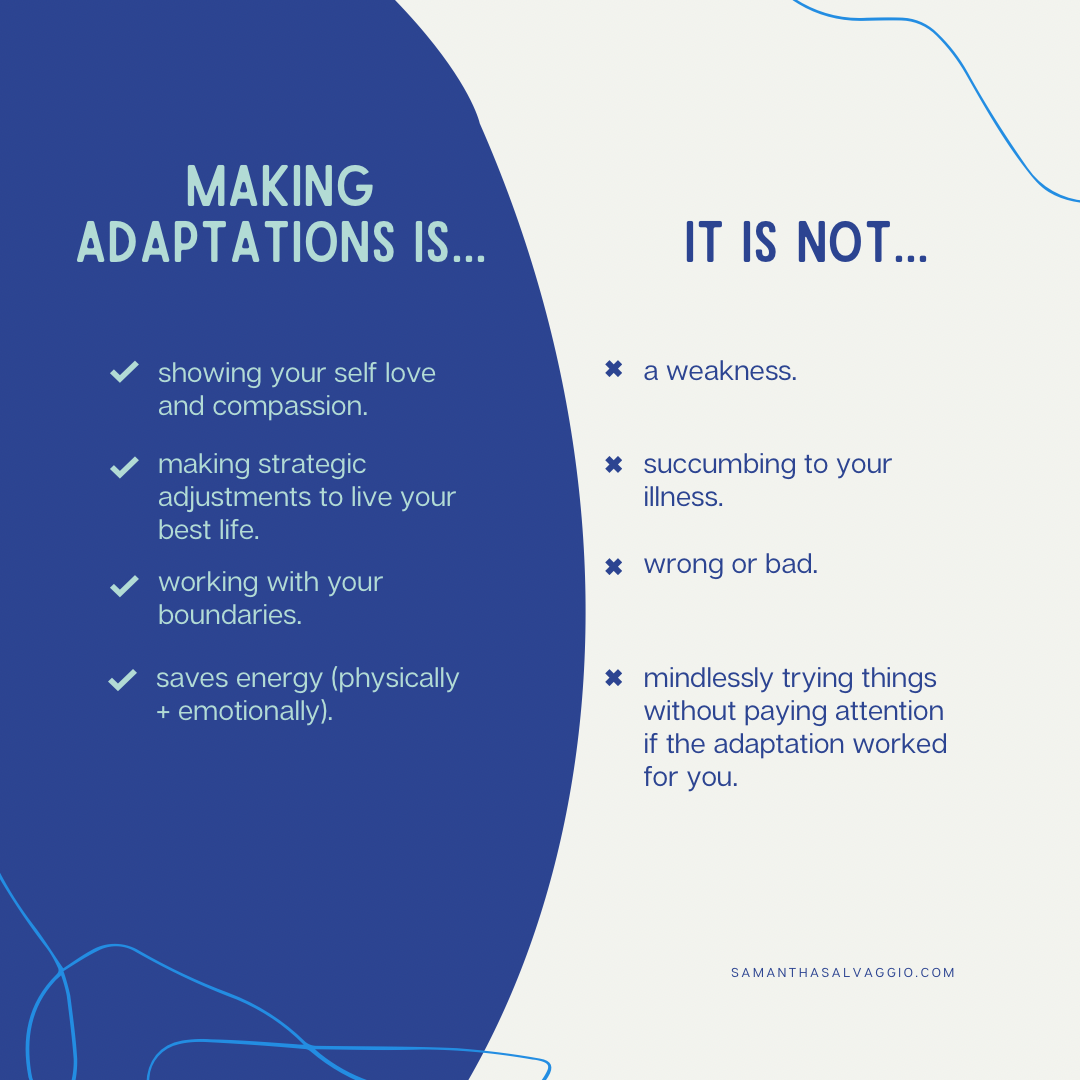
Look, no one wants to ask for help or make adjustments because of their chronic illness. But think about it like this, if it was your friend in the position you’re in, wouldn’t you want them to do what they needed to do to live their best life? And wouldn’t you want to help them if they needed it?
Yes, and YES!
Cool, me too. So now you are going to start treating yourself like you are a friend. Speak to, encourage and support yourself as you would a good friend.
There is NO need to be a huge ass to yourself when you are out there cheering on others. Cheer on YOURSELF too. You deserve it.
Ok, whew. Now that that rant is out of the way let’s get to the important shit…
4 Tips on Adapting
Create Boundaries
Setting boundaries screams I GIVE A FUCK ABOUT MYSELF in the best way possible. You’re basically proclaiming that you love yourself SO much, you’re going to prioritize YOUR health and well-being over anyone else (go you)!
Knowing your own limits with yourself and with other people ensures that you are working towards your goals and building a life you love.
This could be as simple as taking a few moments before getting out of bed to have some quiet time to yourself. Or it could be bigger like stepping away for an hour in the middle of the day to rest and recharge.
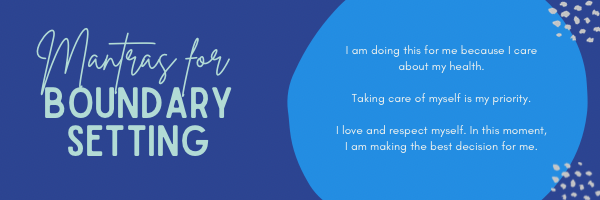
And if you need, create a phrase to repeat to yourself when you feel bad about drawing a boundary. For example…
Build Routines
Routines are like boundaries in action - they are things that add structure and align with the type of life you are working to create.
They provide comfort and are a safe space for us to fall back on.
I have routines in the AM, PM, and throughout the day. Now with the exception of the AM routine, they are all really fucking short, because honestly, who has the time (and energy) for all that?
Not I.
My AM routine is as slow as a drunk snail because that is how I feel in the morning. Instead of fighting my body to get up and going full speed immediately, I take 2-3 hours to eat breakfast and do light work (like computer work or folding laundry). That way I can plant my ass down and give my body time to get it together. It’s a privilege to be able to shift my work day, but it is also almost a necessity at this point. Plus, it allows me to be my best self so I’m going to take it.
A (much) quicker routine I do during the day is sitting in my car for a couple minutes once I get to where I am going (if I can). This gives me a chance to stop and breathe instead of rushing from place to place like a chicken with their head cut off. It keeps me balanced even if MS has other plans.
Think about where you could benefit from adding a routine by identifying where and when you feel ‘off’. What could you do during that time to help you to feel ‘on’ instead?
Make it Work for You
It’s no mystery that needing to adapt to your chronic illness is a swift 1-2 punch in…somewhere you don’t want to be punched.
Not only do you have to adjust to the change (and sometimes explain yourself to others), you are forced to go through the entire grieving process every damn time something changes.
Now you can never fully eliminate either of those things from life with chronic illness. But, you can lessen the burden they place on you by making your chosen adaptations work for you.
For example, I have always been heat intolerant (thanks MS) but the last few years have been next level. Problem is, I love to garden and am outside constantly in the summer (in NC no less). This is problematic.
The first way I thought to adapt to my worsening heat intolerance was to get a cooling vest. I had seen a brochure at my doctor’s office awhile back, but had been holding out because they are a lot (a lot of fabric + a lot of money). No shame to anyone that has one (you do you!), but staying cool is not worth the ridiculous tan lines that would give me.
Is this superficial and may sound beyond stupid to you? Maybe. But, it’s not to me.
I knew I had to make this adaptation but I sure as hell was going to do it on my terms. So, I spent hours looking at alternatives and settled on cooling headbands, wrist wraps and bra inserts. They work great and I am happier than I would have been with a cooling vest. It’s a win-win.
My point is this, there is a creative way to work within your limitations for almost anything - you may need to look harder to find it, but ask other warriors, reach out to your support network, you may be surprised at what you find!
Trial and Error
Let’s get one thing crystal fucking clear first - the ‘error’ part of trial and error is NOT bad.
If you fail, which you will, it is NOT a loss. It is a lesson. Repeat after me - it is a lesson.
Idgaf if after every failure you have to repeat that in your head for days after, do it until you believe it with every fiber of your being.
Next up is one of the biggest rules of trial and error - do the best you can to only change one variable at once. Doing so allows you to really see how that one single change affected you.
To start, pick something that aligns with your goals and try it. Word to the wise, start with trying a small change - bigger isn’t better in this case.
For instance, I used to fight my legs to continue to take indoor cycling classes. The adrenaline would get me through class and I would feel great, until I cooled down. Then my legs felt like concrete for days after.
I knew I needed to adapt, but I still wanted the workout ‘high’ and needed movement for the mental health benefits. I tried dialing it way back and only doing yoga. I liked it, but I needed higher energy and more intensity.
That’s when I started strength training.
That coupled with mobility work gave me what I was looking for - the stretching, the increased mind muscle connection, coordination and strength plus the workout ‘high’ and stress reduction.
It took a failure first, but eventually I found a way to adapt to my changing body and abilities.
At the end of the day, adapting your life for your chronic illness isn’t always easy. But, please know that just because you need to do something differently doesn’t mean it’s wrong or you should be ashamed of it. Uniqueness is something to be embraced and loved, not hidden.